

How to calculate the flow loss in a 90° male elbow?
Nov 04, 2026
In the field of fluid systems, understanding the flow loss in a 90° male elbow is crucial for efficient and effective system design. As a trusted supplier of 90° male elbows, I am well - versed in the technicalities surrounding these components and the importance of calculating flow loss. In this blog, I will guide you through the process of calculating the flow loss in a 90° male elbow, providing you with the knowledge you need to optimize your fluid systems.
The Basics of Flow Loss in a 90° Male Elbow
When a fluid flows through a 90° male elbow, it experiences a change in direction. This change in direction causes the fluid to undergo a series of complex flow phenomena, such as separation, recirculation, and turbulence. These phenomena lead to an increase in the energy loss of the fluid, which is commonly referred to as flow loss.
Flow loss in a 90° male elbow is typically quantified in terms of pressure drop. The pressure drop is the difference in pressure between the inlet and the outlet of the elbow. A higher pressure drop indicates a greater flow loss, which in turn means that more energy is required to maintain the desired flow rate in the system.
Factors Affecting Flow Loss
Several factors influence the flow loss in a 90° male elbow. Understanding these factors is essential for accurate flow loss calculation.
1. Fluid Properties
The properties of the fluid, such as density and viscosity, play a significant role in determining the flow loss. A fluid with a higher density or viscosity will generally experience a greater flow loss due to increased resistance to flow. For example, oil, which has a higher viscosity than water, will have a larger pressure drop when flowing through the same 90° male elbow under the same flow conditions.
2. Flow Rate
The flow rate of the fluid is another critical factor. As the flow rate increases, the velocity of the fluid also increases, leading to more intense turbulence and separation within the elbow. Consequently, the flow loss increases with an increase in flow rate.
3. Elbow Geometry
The geometry of the 90° male elbow, including the radius of curvature, the inner diameter, and the roughness of the inner surface, affects the flow loss. A smaller radius of curvature will cause the fluid to change direction more abruptly, resulting in higher flow loss. Additionally, a rough inner surface can create more friction, further increasing the pressure drop.
Calculation Methods for Flow Loss
There are several methods available for calculating the flow loss in a 90° male elbow. The most commonly used methods are based on the concept of the loss coefficient.
Loss Coefficient Method
The loss coefficient method is a widely accepted approach for calculating the pressure drop in a 90° male elbow. The pressure drop (ΔP) can be calculated using the following formula:
[ \Delta P = K \frac{\rho v^{2}}{2} ]
where:
- (\Delta P) is the pressure drop across the elbow (Pa)
- (K) is the loss coefficient of the 90° male elbow
- (\rho) is the density of the fluid ((kg/m^{3}))
- (v) is the average velocity of the fluid (m/s)
The loss coefficient (K) is a dimensionless quantity that depends on the geometry of the elbow and the flow conditions. For a 90° male elbow, the value of (K) can range from 0.2 to 1.5, depending on the radius of curvature and the Reynolds number.
The Reynolds number ((Re)) is a dimensionless number that characterizes the flow regime. It is calculated using the following formula:
[ Re=\frac{\rho vD}{\mu} ]
where:
- (D) is the inner diameter of the elbow (m)
- (\mu) is the dynamic viscosity of the fluid ((Pa\cdot s))
For laminar flow ((Re < 2000)), the loss coefficient is relatively constant. However, for turbulent flow ((Re> 4000)), the loss coefficient may vary with the Reynolds number and the geometry of the elbow.
Empirical Correlations
In addition to the loss coefficient method, there are also empirical correlations available for calculating the flow loss in a 90° male elbow. These correlations are based on experimental data and take into account the specific characteristics of the elbow and the fluid.
For example, some correlations consider the ratio of the radius of curvature ((R)) to the inner diameter ((D)) of the elbow ((R/D)). A larger (R/D) ratio generally results in a lower loss coefficient.
Practical Applications and Considerations
When designing a fluid system, it is essential to accurately calculate the flow loss in 90° male elbows to ensure optimal performance. Here are some practical applications and considerations:
System Design
In the design of hydraulic or pneumatic systems, minimizing flow loss is crucial for energy efficiency. By accurately calculating the flow loss in 90° male elbows, engineers can select the appropriate elbow geometry and size to reduce the overall pressure drop in the system. This can lead to significant energy savings and improved system performance.
Component Selection
As a supplier of 90° male elbows, I understand the importance of providing high - quality components that minimize flow loss. When selecting a 90° male elbow for your system, consider factors such as the radius of curvature, the inner surface finish, and the material of the elbow. A well - designed elbow with a smooth inner surface and an appropriate radius of curvature can significantly reduce flow loss.
Maintenance and Troubleshooting
Monitoring the pressure drop across 90° male elbows can be an effective way to detect potential problems in a fluid system. An unexpected increase in pressure drop may indicate issues such as blockages, corrosion, or wear in the elbow. Regular maintenance and inspection can help prevent these problems and ensure the long - term reliability of the system.
Related Products
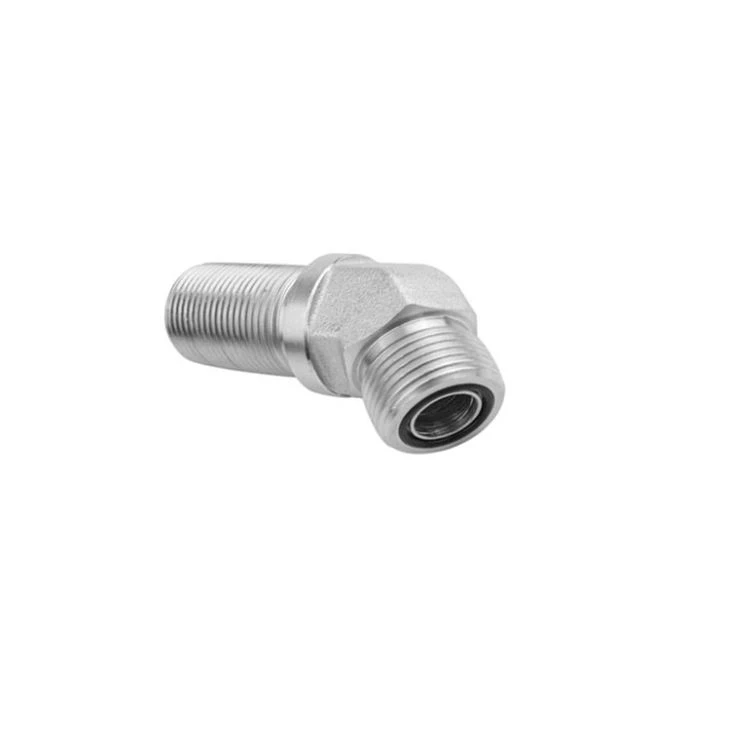
In addition to 90° male elbows, our product portfolio includes a wide range of related products that can enhance the performance of your fluid systems. For example, you may be interested in our Hydraulic Hose Reducer, which can be used to connect hoses of different sizes. We also offer ORFS to O - Ring - Long Hydraulic Pipe Fittings and 45° ORFS Bulkhead Elbow Pipe Fitting, which provide additional flexibility in system design.
Conclusion
Calculating the flow loss in a 90° male elbow is a critical aspect of fluid system design. By understanding the factors that affect flow loss and using the appropriate calculation methods, you can optimize your system for energy efficiency and performance. As a supplier of high - quality 90° male elbows, we are committed to providing you with the products and knowledge you need to succeed in your fluid system applications.
If you are interested in learning more about our 90° male elbows or have any questions regarding flow loss calculation, please feel free to contact us for a detailed discussion. We look forward to the opportunity to work with you and help you achieve your fluid system goals.

References
- White, F. M. (2006). Fluid Mechanics. McGraw - Hill.
- Idelchik, I. E. (1994). Handbook of Hydraulic Resistance. CRC Press.