

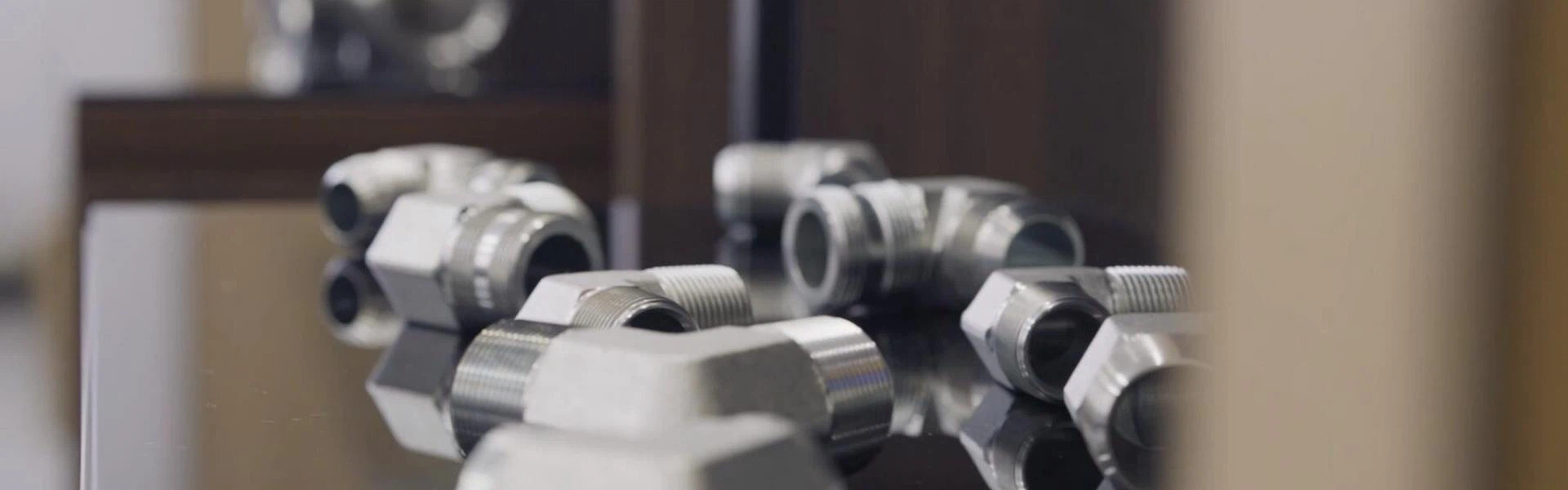
Preventing Leaks at Hydraulic Adapter Fittings
Oct 14, 2026

Whether dealing with hydraulic adapter fittings or other types of pipe connectors, their primary function is to join sections of piping. Wherever a connection exists, there is a potential point of failure; consequently, it is impossible to guarantee that leaks will never occur at these joints without proactive preventive measures.
Leakage issues affect various components within hydraulic systems-not just adapter fittings, but also metal pipe fittings and hose connectors. For bite-type (ferrule) fittings, leaks often result from significant external force or impact causing the ferrule to loosen or the pipe end to deform; in such cases, one should inspect the ferrule for loss of roundness or damaged cutting edges, check the condition of the pipe end, and verify the tightness of the ferrule nut. For flared fittings, leakage is frequently caused by over-flaring, leading to deformation or cracking; the solution here is to cut off the flared section and re-flare the pipe end.
Leakage can also occur in fittings-including hydraulic adapters-that rely on O-rings for sealing against an end face or outer diameter. Common causes include O-ring aging or deformation; improper assembly resulting in uneven compression or the O-ring being cut during installation; insufficient compression or elastic deformation; or a counterbore groove that is too deep. To address these issues, one should select a replacement O-ring with the same outer diameter but a thicker cross-section. Regardless of the material, the first step is to inspect the seal for damage, deformation, aging, or excessive surface roughness, and then take appropriate corrective action.


