How To Source Ferrule For 4SP Made in China Reliably
Apr 27, 2026
Introduction
Sourcing a ferrule for 4SP made in China can reduce procurement costs, but these parts sit in high-pressure hydraulic assemblies where small dimensional or material errors can lead to leaks, hose damage, and expensive failures. The key is not simply finding a low quote, but verifying whether a supplier can consistently meet the crimping, tolerance, coating, and compatibility requirements of EN 856 4SP applications. This article explains how to assess Chinese manufacturers, compare technical specifications, confirm quality control, and manage commercial risks so you can buy with more confidence and avoid problems that only appear after production or field use.
Why Sourcing 4SP Ferrules from China Requires Careful Evaluation
Procuring a ferrule for 4SP made in China presents a compelling opportunity for hydraulic hose assemblers and equipment manufacturers to optimize their production costs. However, because EN 856 4SP hoses utilize four layers of high-tensile steel wire spiral designed for extreme high-pressure applications, the ferrule must exhibit flawless structural integrity. Sourcing these critical components requires moving beyond basic catalog browsing to conduct rigorous engineering and commercial evaluations, ensuring the chosen manufacturer adheres to strict international hydraulic standards.
Performance, cost, and application requirements
The primary function of a 4SP ferrule is to maintain a secure, leak-free crimp under severe hydraulic loads. Depending on the hose bore size, working pressures for 4SP assemblies can easily reach up to 450 bar (approximately 6,525 psi), accompanied by constant mechanical vibrations and rapid pressure surges. Chinese manufacturers can frequently offer cost reductions ranging from 15% to 30% compared to premium European or North American suppliers.
To capitalize on these savings without jeopardizing system performance, buyers must ensure the ferrule's internal geometry matches the specific skive or no-skive requirements of their chosen hose brand. The internal teeth of the ferrule must be engineered to bite firmly into the wire reinforcement without severing the steel strands during the swaging process.
Failure risks, hidden costs, and trade-offs
Failing to scrutinize suppliers exposes buyers to severe operational risks and hidden financial burdens. If a ferrule lacks the correct annealing treatment, it may remain too brittle, leading to micro-fractures during the high-force swaging process. Conversely, overly soft metal will result in insufficient grip, causing catastrophic hose blow-offs during pressure spikes in the field.
The hidden costs of these failures-ranging from heavy machinery downtime and environmental fluid spills to severe safety hazards for operators-far outweigh the initial unit savings. In the high-pressure hydraulics industry, accepting a defect rate higher than 0.2% to 0.5% is an unacceptable trade-off that compromises the reliability and safety of the entire hydraulic assembly.
Key Technical Specifications and Comparison Criteria
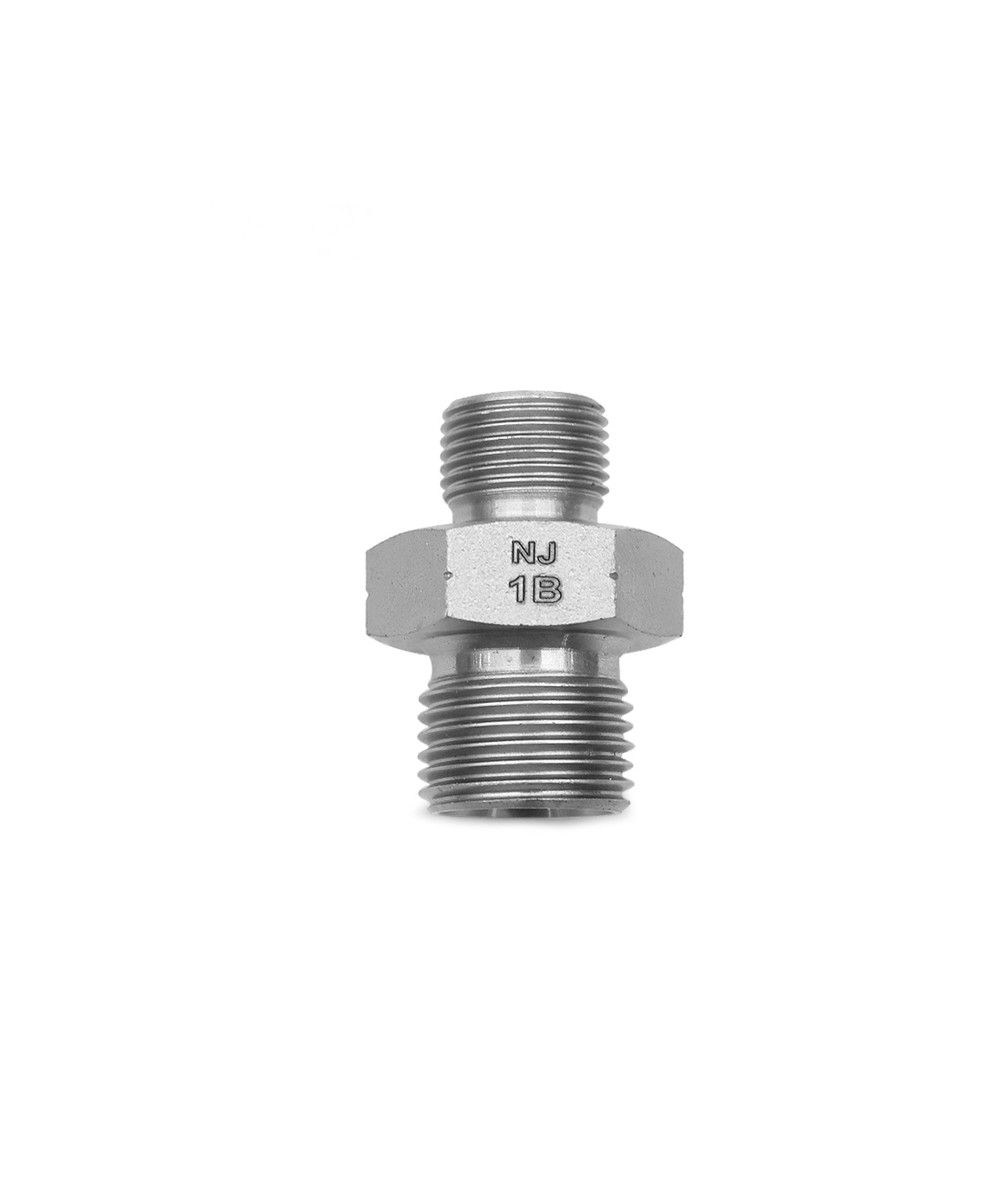
Validating a ferrule for 4SP made in China requires a systematic comparison of metallurgical properties, machining precision, and surface finishing standards. Relying solely on visual inspections or basic dimension checks is highly insufficient for components subjected to high-impulse hydraulic environments.
Dimensional tolerances, material grade, and surface treatment
The foundation of a reliable ferrule lies in its material composition and subsequent heat treatment. Most high-quality Chinese ferrules are machined from 20# carbon steel (closely equivalent to AISI 1020), which offers the ideal balance of tensile strength and ductility necessary for uniform cold deformation during crimping. Proper annealing is a critical step, targeting a controlled hardness level of 130 to 150 HV to prevent cracking under the crimper's dies.
Additionally, surface treatment dictates environmental longevity and corrosion resistance. High-grade zinc plating with trivalent chromate passivation should be standard practice to meet modern environmental compliance and operational demands.
|
Specification Area |
Standard Requirement |
Premium Benchmark (China) |
|
Material Grade |
20# Carbon Steel / Q235 |
20# Carbon Steel (Fully Annealed) |
|
Dimensional Tolerance |
±0.10 mm |
±0.05 mm (CNC Machined) |
|
Hardness |
150-180 HV |
130-150 HV (Optimal Ductility) |
|
Corrosion Resistance |
72 hours to red rust |
96 - 120+ hours (ASTM B117) |
Supplier comparison and benchmarking factors
When benchmarking potential manufacturing partners, buyers should deeply evaluate their production infrastructure. Leading suppliers utilize multi-axis CNC lathes rather than manual or semi-automatic machines, ensuring the internal teeth, locking grooves, and overall lengths maintain strict tolerances of ±0.05 mm.
Buyers should also benchmark suppliers based on their quality control equipment, specifically looking for in-house optical comparators, hardness testers, and salt spray chambers. A supplier's ability to consistently replicate these internal geometries across production runs of tens of thousands of units is what separates a reliable manufacturing partner from a high-risk vendor.
How to Qualify Suppliers and Manage the Sourcing Process

Navigating the Chinese industrial manufacturing landscape requires a strategic, step-by-step approach to vetting and onboarding. Major hydraulic component hubs, such as Ningbo, Yuyao, and Cangzhou, host hundreds of suppliers with vastly different capabilities, quality control maturity, and business models.
Practical supplier qualification and sourcing steps
The qualification sequence should begin with auditing the supplier's ISO 9001:2015 certification and requesting comprehensive Material Test Reports (MTRs) for recent batches. Before committing to volume production, buyers must procure a sample run of 100 to 200 pieces.
These samples should be swaged onto the target 4SP hose and subjected to rigorous burst testing and impulse fatigue testing, aiming to clear the standard 400,000 cycles required by the ISO 6803 standard. Once technical validation is complete, buyers can negotiate commercial terms. Standard Minimum Order Quantities (MOQs) for specific 4SP ferrules typically range from 1,000 to 3,000 pieces per size. Buyers should plan for average production lead times hovering between 25 and 35 days, excluding ocean freight transit.
Factory, trader, and service model comparison
A critical decision in the sourcing process is choosing between a direct factory and a trading company. Direct factories offer the lowest unit costs, transparent traceability, and the ability to implement custom engineering changes directly with the production floor. However, they may demand higher MOQs and focus strictly on their specific manufacturing catalog.
Trading companies, conversely, can consolidate ferrules, hose fittings, and adapters from multiple regional factories into a single shipment, though they typically apply a 10% to 15% markup for this service. For critical components like high-pressure 4SP ferrules, partnering directly with a specialized CNC machining factory is generally the safest strategy. It eliminates communication barriers regarding technical specifications and ensures strict adherence to quality control protocols prior to export.
Key Takeaways
The most important conclusions and rationale for Ferrule For 4sp Made in China
Specs, compliance, and risk checks worth validating before you commit
Practical next steps and caveats readers can apply immediately
Frequently Asked Questions
What material is best for a 4SP ferrule made in China?
Choose fully annealed 20# carbon steel. It offers the ductility needed for crimping while maintaining strength for high-pressure 4SP hose assemblies.
What hardness range should a reliable 4SP ferrule have?
Target 130–150 HV after annealing. This helps prevent cracking during swaging while keeping enough grip on the hose reinforcement.
How tight should dimensional tolerance be for 4SP ferrules?
Prefer suppliers holding ±0.05 mm with CNC machining. This improves crimp consistency, fit, and sealing reliability across large production runs.
How can I verify corrosion resistance before ordering?
Ask for salt spray test results showing 96–120+ hours to red rust, plus details of zinc plating and trivalent chromate passivation.
What is the safest way to qualify a Chinese 4SP ferrule supplier?
Request samples, material certificates, hardness data, tolerance reports, and crimp test results on your exact hose type before placing a bulk order.